Container Glass Recycling
The client, a UK Glass Container Manufacturer, in common
with other manufacturers, had been involved in container glass
recycling for many years, and only lately had legislation been
effected with regard to producer responsibility for Packaging Waste.
The combination of this and other legislation, including Climate
Change Levy and Landfill Tax, had created a complex environment
within which to plan and execute recycling strategies.
Since the
introduction of the Packaging Waste regulations, the UK recycling
statistics had improved slightly but not to any great incremental
extent with respect to performance prior to the legislation. While
markets had been identified and developed for all waste glass,
some of which could not be effectively used in closed loop recycling,
the major blockage to improved national recycling performance remained
the capture of packaging at the point it becomes waste.
The client both needed and wished to be a
significant player in container glass recycling in the UK. Packaging
recycling is required at law and the reprocessing of cullet presents
benefits in terms of maintaining output, energy savings, climate
change, emissions trading and furnace life.
The packaging supply chain and ultimately
the container producers are obligated to achieve the recycling
targets and recycling waste glass achieves both the producer’s
own obligations and those of the packer filler and retailer. Failure
to achieve them reduces the competitiveness of glass and may ultimately
threaten the viability of the glass container industry in the UK.

The project was structured in four phases:
- Project Definition involving the client and their strategic
material
- Strategy Development
- Implementation Planning and Review
- Strategy Implementation
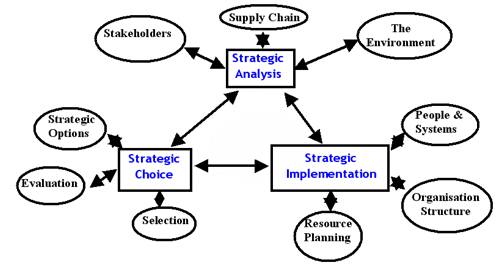
The strategic development model adopted is outlined below.
The
role of the consultants was to; Provide Project Methodology, undertake
research and analysis on behalf of client, coordinate and leverage
client resources, liaise with outside parties as necessary (e.g.
WRAP, BG, DEFRA, Local Authorities etc), expedite and manage the
programme and risks, facilitate discussions and secure decisions
and ownership and record details of the analysis and resultant
decisions.
The assignment was for two years and involved two experienced
consultants.
- The initial study programme was structured to:
- Meet key players at the client, their recyclate supplier,
British
Glass and the compliance scheme
- Assess the joint organisational
resources
- Review the subject matter (Legislation etc)
- Define the
Strategy Development Project
- The subsequent Strategy Development consisted of:
- Use of an
established Strategic Planning methodology
- Establishing
the joint client / supplier / consultant Project
Team
- Review of the Environment, Stakeholders & Supply
Chain
- Comprehensive information gathering and identification
of key
influences
- Detailed strategic analysis (strategy audit)
- Debate, definition
and agreement on the strategic intent and
the approach to be adopted to deliver the strategy, which
was
documented in a concise report
- Implementation Planning included:
- Development of implementation approach
- Establishment of
draft implementation plans
- Determination of resource requirements
- Setting up the Packaging
Recovery Note budgeting process
- Review of resources against
budget constraints
- Finalisation of implementation plans
- Setting up a process
for reviewing progress and developing new
Plans
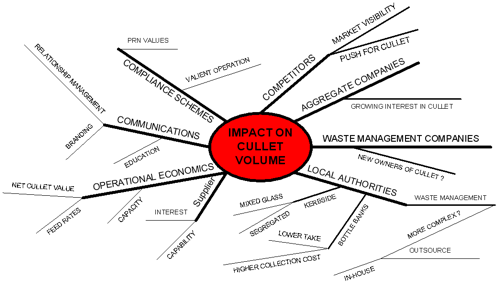
As the map depicts, the issues arising from the review at that
time, were complex and multi-faceted, requiring the engagement
of a range of external stakeholders as well as the executive and
managers of both the client and key supplier organisations.
A Collaborative
Venture Management Group was set up to co-ordinate the working between
the client and the key supplier and this was managed by the consultants.
The Project resolved into four main areas each of which had its own
strategy, goals and implementation programme:
- External Affairs
- Cullet Usage Potential (recovered & processed waste glass)
- Feedstock Acquisition (unprocessed waste glass)
- Process
Optimisation
External Affairs encompassed the understanding of Legislation
as it affected the industry and actual and potential suppliers:
- working closely with British Glass to share information to
advance the understanding of the effects of industry and government
strategies;
- examining the market of Compliance Schemes to
help predict their actions and assess the value of entering
such a market;
- and establishing with the support of a marketing
company, industry and local authority communication forums
on multi-materials, to provide regular interaction with speakers
and senior representatives from both the public and private
sector, including for example: DEFRA; WRAP; APSWG; LARAC; London
Remade various Trade Associations and numerous manufacturing
and waste management companies.
The Cullet usage potential section covered:
- Formulations and Specifications involving a comprehensive
review of existing quality standards and monitoring processes
- End Markets - taking the WRAP studies conducted by Enviros,
each of the possible end markets was reviewed and sales proceeds
and on-costs and transportation costs expected for each, were
assessed
- Economics - the predictive model developed in the
strategy development phase was refined and enhanced. New data
was input on a regular basis and decisions made about key contracts
to pursue, both in terms of acquisition and also sales of PRNs
and surplus material
Feedstock Acquisition was divided into:
- Communications – once the collaborative venture was
well established, the external work was integrated into the project
being handled by a PR / marketing company
- Marketing - an initial
campaign was undertaken with key regional Local Authorities and
County Councils. The meetings gave the opportunity to discuss
market issues as well as promoting the communication and recycling
efforts of the client, using the vehicle of a newly developed
brand, supported by forums and an information website resource
- Contracting – encompassed
internal discussions about pricing and desirability of particular
potential contracts, and participation in the external relationships.
Process Optimisation work built-in:
- Existing Facilities - a project was established to review
all areas of the cullet systems and apply engineering ‘hits’ to
rectify areas of concern. Under the client ownership, a 5S
project was established in the batch and furnace department
to address continuing issues of appearance and performance
- Facilities Planning – a review of in-line colour enhancement
and contaminant removal; a review was undertaken about providing
extended cullet processing at the internal cullet storage facilities
Outcome
External Affairs
- Shared understanding of UK supply and demand and economics
of glass recycling reached within British Glass membership.
- Project
developed to launch integrated recycling compliance scheme.
- Brought
together industry and public sector in the area of recycling
Cullet
Usage Potential
- Technology for colour separation and enhancement
proven
- Economic Model developed and refined
- Material placed to export
markets and alternative markets in the UK
- Integrated reporting
of supply, consumption, sales and inventory volumes
Feedstock Acquisition
- Support to launch of branded web based Information resource,
including website technical content
- Marketing and promotion of
brand, including developing relationships with key northern Local
Authorities
- Modelling of acquisition volumes by source and type
including prediction of future volume profile
Process Optimisation
- Installation of contaminant detection equipment
on finished bottles on all lines on a single furnace, increasing
usage potential by up to 20kT per annum
- Study on retrofitting contaminant
removal plant on cullet feed operations
::
Archive Case Studies |